In the fields of biostatistics, clinical research, epidemiology, and public health, few concepts are as fundamental and as frequently misunderstood as correlation and causation. Researchers, clinicians, regulators, and policymakers routinely rely on statistical evidence to make decisions that affect patient care, drug approvals, disease prevention strategies, and healthcare guidelines. Misinterpreting a statistical association as a causal relationship can lead to incorrect conclusions, unsafe interventions, and misguided public health policies.
The distinction between correlation vs causation is especially critical in biomedical research, where data are often observational, complex, and influenced by multiple biological, environmental, and behavioral factors. While correlation helps identify relationships between variables, causation explains whether one factor truly produces a change in another. Understanding this difference is central to evidence-based medicine.
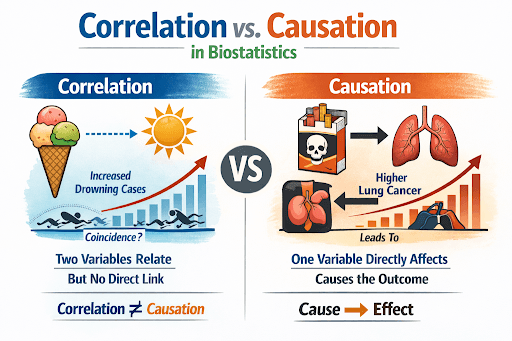
Understanding Correlation in Biostatistics
In biostatistics, correlation refers to a measurable statistical association between two variables. When two variables change together in a systematic way, they are said to be correlated. Importantly, correlation does not indicate whether one variable causes the other to change.
Correlation answers the question:
Are two biological or clinical variables associated with one another?
Common correlation measures used in biomedical research include:
- Pearson's correlation coefficient (r) for continuous, normally distributed variables
- Spearman's rank correlation for non-parametric or ordinal data
- Kendall's tau for small samples or tied ranks
These methods are widely applied to laboratory measurements, biomarker studies, physiological parameters, and population health data.
Types of Correlation in Biomedical Data
1. Positive Correlation
Both variables increase or decrease together.
Example: Body mass index (BMI) and systolic blood pressure often show a positive correlation.
2. Negative Correlation
One variable increases while the other decreases.
Example: Physical activity level and fasting blood glucose concentration.
3. No Correlation
No meaningful relationship between variables.
Example: Blood group and cognitive ability.
These patterns indicate association only and do not imply biological causation.
Understanding Causation in Biostatistics
Causation exists when a change in one variable directly produces a change in another. In biomedical research, causation implies that an exposure, intervention, or risk factor is responsible for a specific health outcome.
Causation answers the question:
Does altering an exposure or treatment directly lead to a change in a clinical or biological outcome?
Establishing causation typically requires:
- Temporal precedence (cause precedes effect)
- Control of confounding variables
- Consistency across multiple studies
- Biological or mechanistic plausibility
Correlation and Causation: Key Differences
| Aspect | Correlation | Causation |
|---|---|---|
| Meaning | Statistical association | Direct cause-and-effect |
| Directionality | Not implied | Clearly defined |
| Confounding variables | Common | Controlled or minimized |
| Typical evidence | Observational studies | Experimental or causal inference studies |
| Regulatory acceptance | Hypothesis-generating | Decision-making evidence |
This distinction underpins the entire correlation vs causation also debate in medical research.
Why Correlation Does Not Imply Causation?
In healthcare and epidemiology, correlations often arise due to factors unrelated to direct causation. Common reasons include:
- Confounding variables (e.g., age, sex, socioeconomic status)
- Reverse causality (the outcome influences the exposure)
- Selection bias
- Measurement bias
For this reason, researchers emphasize that correlation alone is insufficient to establish cause and effect.
Correlation vs Causation Example in Epidemiology
Ice Cream Consumption and Heat-Related Illness
- Observation: Ice cream consumption correlates with heat stroke incidence.
- Correlation: Yes
- Causation: No
- Explanation: Ambient temperature is the confounding variable influencing both.
This classic correlation vs causation example is frequently used in epidemiology training.
Example of Causation and Correlation in Clinical Research
Smoking and Lung Cancer
- Observation: Smoking is strongly associated with lung cancer.
- Correlation: Yes
- Causation: Yes
- Explanation: Supported by cohort studies, randomized evidence, dose–response relationships, and biological mechanisms.
This is a definitive example of causation and correlation in biomedical science.
Causal Correlation Examples in Biomarker Studies
LDL Cholesterol and Cardiovascular Disease
- Observation: Elevated LDL cholesterol correlates with increased cardiovascular risk.
- Correlation: Yes
- Causation: Yes
- Explanation: Randomized trials show that lowering LDL reduces cardiovascular events.
This is one of the most widely cited causal correlation examples used in clinical guidelines.
Cause and Effect vs Correlation in Public Health
Public health research frequently relies on observational data, making it especially vulnerable to confusion between cause and effect vs correlation.
For example:
- Air pollution levels correlate with respiratory morbidity
- Vaccination coverage correlates with reduced disease incidence
Only through rigorous causal analysis can these associations be translated into policy recommendations.
Correlation Causation Example Involving Confounding
Alcohol Consumption and Cardiovascular Risk
Some studies suggest moderate alcohol intake correlates with lower cardiovascular risk. However, this correlation causation example is complicated by confounders such as diet, income, and lifestyle factors.
Without proper adjustment, causation cannot be confidently inferred.
Correlation v Causation Examples in Clinical Trials
Randomized controlled trials (RCTs) are designed to minimize confounding and allow causal interpretation. However, even within RCTs, secondary analyses can produce misleading correlations.
For example:
- Subgroup correlations may not reflect true treatment effects
- Post-hoc associations may be spurious
Understanding correlation v causation examples is essential for correct trial interpretation.
Methods Used to Move from Correlation to Causation
Biostatisticians use multiple approaches to establish causation:
- Randomized Controlled Trials (RCTs)
- Prospective Cohort Studies
- Multivariable Regression Models
- Propensity Score Matching
- Instrumental Variable Analysis
- Causal Inference Frameworks (DAGs, Counterfactual Models)
These methods strengthen causal conclusions beyond simple correlation.
Common Pitfalls in Interpreting Correlation and Causation
Interpreting correlation correctly is critical in biostatistics, clinical research, and data-driven decision-making. While correlations help identify relationships between variables, they are often misunderstood or overstated. The following pitfalls explain why correlation alone can be misleading and why careful analysis is essential before drawing conclusions.
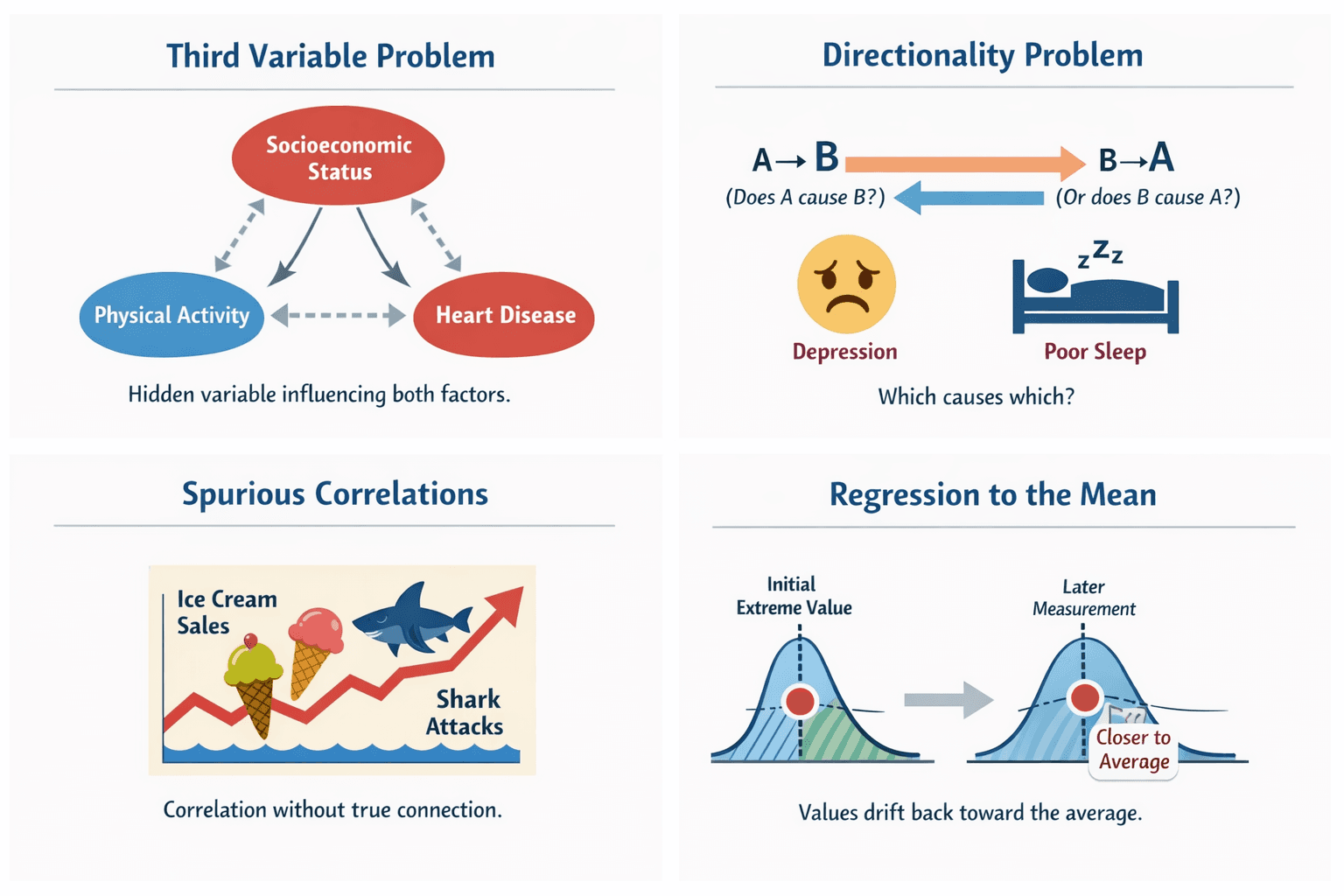
Third Variable Problem
One of the biggest pitfalls in correlation studies is the third variable problem. This occurs when a hidden or unmeasured variable influences both variables being studied, creating the illusion of a direct relationship between them.
Example:
For example, a correlation may be observed between regular exercise and reduced cardiovascular disease risk. While exercise may indeed be beneficial, the association may also be influenced by factors such as socioeconomic status, access to healthcare, or dietary habits. These third variables affect both physical activity levels and health outcomes, complicating causal interpretation.
Why it matters:
Ignoring third variables can lead to incorrect conclusions and flawed decision-making, especially in health, social science, and business research.
Directionality Problem
The directionality problem arises when it is unclear which variable is the cause and which is the effect. Correlation tells us that two variables are related, but it alone cannot determine which variable influences the other: does A cause B, or does B cause A?
Example:
There is a correlation between stress levels and poor sleep quality.
- Does stress cause poor sleep?
- Or does poor sleep increase stress?
Both explanations are possible, and correlation alone cannot determine the direction of the relationship.
Why it matters:
Assuming direction without proper experimental or longitudinal evidence can lead to misleading claims about cause and effect, therefore without longitudinal data or experimental design, correlation alone cannot resolve directionality, making causal interpretation unreliable.
Spurious Correlations
Sometimes, two variables appear to be correlated purely by coincidence. These are known as spurious correlations and are often humorous or absurd. Spurious correlations refer to statistical associations that exist purely by chance rather than through any meaningful biological or causal mechanism. These correlations can appear convincing, especially in large datasets with many variables.
Example: Some famous examples include correlations between unrelated variables such as disease rates and non-health-related behaviors. While these correlations can appear statistically strong, they lack biological plausibility and clinical relevance.
Why it matters:
Spurious correlations highlight the danger of blindly trusting numerical results without applying scientific reasoning and domain knowledge.
Regression to the Mean
Regression to the mean refers to the tendency of extreme values to move closer to the average upon repeated measurement.
Example:
In clinical studies, patients with extremely high baseline measurements (such as blood pressure or glucose levels) may show improvement over time even without effective intervention. This can create the false impression of a treatment effect when none exists.
Why it matters:
This phenomenon can be mistaken for a real effect or intervention outcome, especially in medical and psychological studies.
Can There Be Causation Without Correlation?
Yes, causation can exist without a strong observable correlation.
Example:
A medication may significantly reduce the risk of a rare disease. While the drug clearly causes a beneficial effect, the overall correlation between taking the drug and disease occurrence may appear weak because the disease itself is uncommon.
Why causation may not show correlation?
- Effects occur only under specific conditions
- Relationships are non-linear
- Data contains noise or measurement error
- Time delays mask the relationship
Lack of correlation does not always mean lack of causation, just as correlation does not guarantee causation.
Correlation is a valuable analytical tool, but it is only the starting point. Without careful consideration of confounding, directionality, bias, and biological plausibility, correlations can easily be misinterpreted. Sound study design, appropriate statistical methods, and critical thinking are essential to avoid these common pitfalls.
How to Prove Causation, Not Just Correlation?
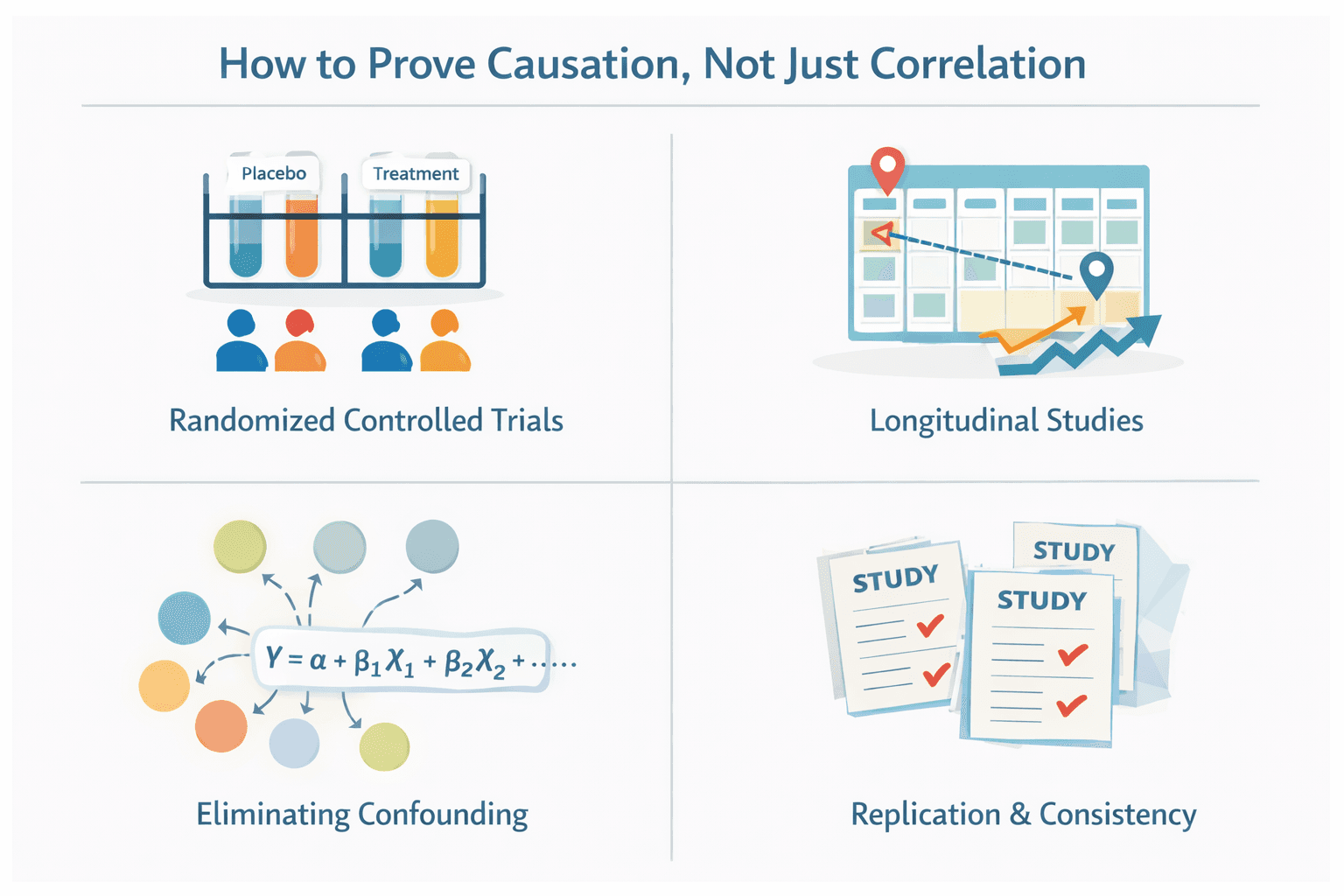
Establishing causation requires more than observing a statistical association. Researchers must carefully design studies and analyze data to demonstrate that a variable truly produces an effect, rather than just being associated with it. Several key principles help guide this process:
- Cause precedes effect: The suspected cause must happen before the outcome, often shown using time-based or longitudinal studies.
- Control confounding variables: Other factors that may influence both variables must be accounted for or eliminated.
- Use experiments: Randomized controlled trials isolate the effect of one variable, making causal claims stronger.
- Explain the mechanism: A clear logical, biological, or theoretical explanation strengthens causation.
- Consistency of results: The relationship should appear across multiple studies, settings, and populations.
- Dose–response relationship: Increasing exposure should increase (or decrease) the effect in a predictable way.
Key point: Correlation shows association; causation requires careful study design and supporting evidence.
How to Avoid the Correlation–Causation Error?
Avoiding common errors is critical for researchers to make valid conclusions. By following these guidelines, one can reduce the risk of misinterpreting statistical associations:
- Don't assume cause and effect: A correlation only shows association, not that one variable causes the other.
- Check for third variables: Look for hidden factors that may influence both variables.
- Consider directionality: Ask whether A causes B, B causes A, or both influence each other.
- Use proper study design: Prefer experiments or longitudinal studies over single-time observations.
- Apply logical reasoning: Ensure the relationship makes scientific or real-world sense.
- Seek supporting evidence: Confirm findings with multiple studies or methods.
Real-World Examples of Causation and Correlation in Healthcare
In healthcare, causal relationships are rarely obvious, and each requires careful evaluation before making clinical recommendations. Examples include:
- Biomarker levels and disease severity
- Medication adherence and survival outcomes
- Screening programs and mortality reduction
- Lifestyle interventions and chronic disease risk
Each requires careful evaluation before causal claims are made.
Regulatory and Ethical Implications
Regulatory agencies such as the FDA and EMA require robust causal evidence before approving drugs or public health interventions. Confusing correlation and causation can delay approvals or lead to rejection of studies.
Ethically, researchers have a responsibility to communicate findings accurately and avoid overstating causal claims.
Why Correlation vs Causation Matters in Biostatistics?
Understanding the distinction between correlation and causation is essential for reliable scientific conclusions and decision-making. Proper interpretation ensures:
- Safer clinical decision-making
- Reliable public health policies
- Valid scientific conclusions
- Trust in biomedical research
Biostatistics plays a central role in guiding these outcomes, supporting evidence-based medicine and responsible research.
FAQ
Because incorrect causal claims can lead to unsafe treatments and flawed guidelines.
They can suggest causation when supported by strong design, consistency, and biological plausibility, but RCTs remain the gold standard.
No. Correlations are essential for hypothesis generation and exploratory analysis.
They can create false or exaggerated associations if not properly controlled.
No. Statistical significance indicates association, not cause and effect.
Because much biomedical data is observational and requires advanced methods to estimate causal effects.
Conclusion
In biostatistics and biomedical research, clearly distinguishing between correlation and causation is essential for accurate interpretation of clinical, epidemiological, and public health data. While correlations highlight important associations, they do not by themselves establish cause-and-effect relationships. Careful study design, appropriate statistical methods, and biological reasoning are required to draw valid causal conclusions.
As emphasized throughout this discussion, no statistical software alone can convert correlation into causation, however BioStat Prime is designed to support this critical analytical journey from exploratory correlation analysis to more advanced statistical modeling that helps researchers move closer to causal understanding. By enabling precise correlation analysis, multivariable modeling, regression techniques, and controlled comparisons, BioStat Prime empowers biostatisticians, clinical researchers, and public health professionals to evaluate data relationships responsibly and transparently.